
Buy Premium Microsilica for Concrete Silica Fume Export at Best Price
- Silica Fume, also known as Microsilica, is an ultra-fine pozzolanic material containing 90–96% amorphous silicon dioxide (SiO₂) and is widely used to produce high-performance concrete.
- Its extremely fine particles improve concrete strength, density, and durability while significantly reducing permeability and chemical penetration.
- Microsilica enhances resistance to sulfate attack, chloride ingress, abrasion, and reinforcement corrosion, making it ideal for marine structures, bridges, dams, and industrial flooring.
- The product is commonly used at a dosage of 5–12% of cement weight and is available in powder, densified, granulated, and slurry forms.
- Complying with ASTM C1240 standards, Silica Fume is exported worldwide in jumbo bags and bulk shipments for advanced construction applications.


Microsilica (Silica Fume) for Export at Competitive Prices
Silica Fume is an ultra-fine grey powder with high pozzolanic reactivity that is widely used to improve the performance and durability of concrete. It is a by-product of electric arc furnaces during the production of ferrosilicon alloys and contains a high percentage of amorphous silicon dioxide (SiO₂).
Due to its extremely fine particle size, Microsilica significantly increases the strength, density, and impermeability of concrete while reducing permeability to water and aggressive chemicals. It is considered one of the most important mineral admixtures for producing high-performance and durable concrete.
Product Features
- High SiO₂ content (90–96%)
- Ultra-fine particle size with an average diameter of approximately 0.1 micron
- Excellent pozzolanic activity
- Improves concrete durability and mechanical properties
- Reduces chloride and sulfate penetration
- Increases resistance to abrasion and corrosion
- Suitable for high-performance and ultra-high-performance concrete (UHPC)
Main Applications of Microsilica
- Marine and coastal structures
- Bridges, ports, and offshore construction
- Dams, reservoirs, and water channels
- Tunnels and underground structures
- Industrial flooring and precast concrete elements
- High-strength and waterproof concrete production
- Concrete exposed to severe chemical environments
Advantages of Using Microsilica in Concrete
- Higher compressive strength
- Improved tensile and flexural strength
- Reduced water permeability
- Better resistance to sulfate attack
- Protection against reinforcement corrosion
- Reduced alkali-aggregate reaction
- Improved freeze-thaw resistance
- Enhanced long-term durability
- Reduced cement consumption
- Better surface finish and concrete density
Recommended Dosage
Microsilica is generally used at a dosage of 5% to 12% of the cement weight. Due to its high surface area and water demand, the use of a suitable superplasticizer is recommended to maintain workability and prevent cracking.
Available Forms
- Undensified Microsilica Powder
- Densified Microsilica
- Granulated Microsilica
- Slurry Microsilica
Packaging Options
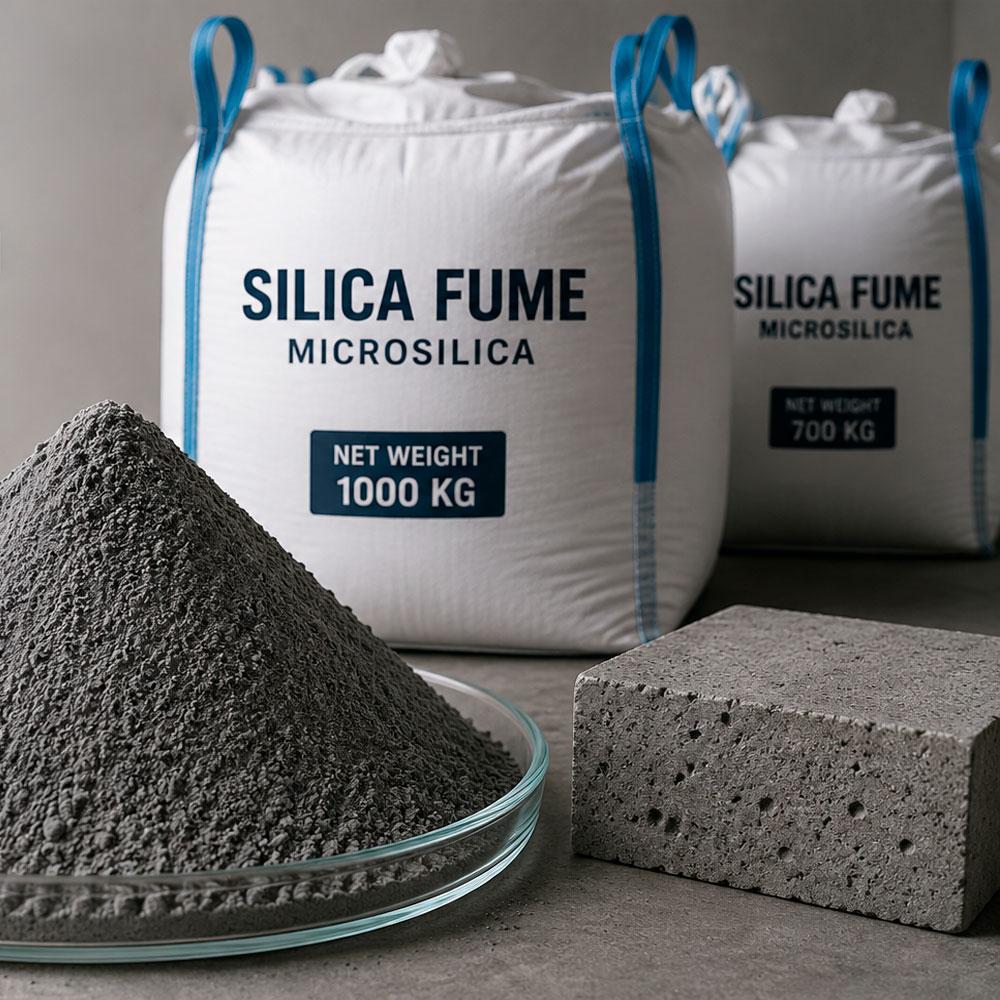
- 1,000 kg Jumbo Bags
- 700 kg Jumbo Bags
- Customized packaging upon request
Typical Chemical Analysis
| Chemical Component | Typical Value (%) |
|---|---|
| SiO₂ | 94 – 96 |
| Al₂O₃ | 0.3 – 0.8 |
| Fe₂O₃ | 0.2 – 0.6 |
| CaO | 0.2 – 0.8 |
| MgO | 0.3 – 1.0 |
| K₂O + Na₂O | 0.5 – 1.5 |
| Carbon | 0.5 – 2.0 |
| Moisture | < 3 |
| Loss on Ignition | < 6 |
Physical Properties
| Property | Typical Value |
|---|---|
| Appearance | Light Grey Powder |
| Particle Shape | Amorphous Spherical Particles |
| Average Particle Size | 0.1 μm |
| Specific Gravity | 2.20 |
| Bulk Density | 500–650 kg/m³ |
| Specific Surface Area | 15–30 m²/g |
| Pozzolanic Activity Index | >115% |
Recommended Export Methods
Jumbo Bags
Microsilica is commonly exported in 700 kg and 1,000 kg jumbo bags, providing efficient handling and cost-effective transportation for international shipments.
Container Shipment
A 20-foot container can typically load between 18 and 22 metric tons of densified microsilica, depending on the packaging configuration.
Bulk Vessel Shipment
For long-term contracts and large-volume requirements exceeding 5,000 metric tons, bulk vessel shipments provide the most economical freight solution.
Recommended Shipping Terms
- FCA – For neighboring countries and land transportation.
- CFR – For sea shipments where the seller arranges ocean freight.
- CIF – For shipments including ocean freight and marine insurance.
- DAP/DDP – For turnkey deliveries directly to the buyer's destination.
Storage and Handling
Microsilica should be stored in dry and covered conditions, protected from moisture and direct contact with water. Proper storage ensures the material maintains its high reactivity and performance characteristics.
International Standard
Microsilica used in cementitious mixtures generally complies with ASTM C1240, the internationally recognized standard specification for silica fume used in concrete and mortar applications.
Add your review
Your email address will not be published. Required fields are marked *
Please login to write review!
Looks like there are no reviews yet.

by Abrisham Road
Inspection group .co

Pars Silica Company
 From Iran


- Store rating
0
- Staff
> 10
- Offers
> 100
- Products
17